Tuesday, April 16, 2013
LAD/Blog #37: Brown v. Board of Education
Educational segregation in Topeka, Kansas forced a black girl, Linda Brown, to walk an undeserved extra distance to school every day solely because of her race. She, alongside the NAACP, filed a suit against the state of Kansas on the grounds that the learning of black schoolchildren was inhibited by segregation and had to end. The court ruled against Linda Brown, but the NAACP wouldn't take such a verdict and appealed to the U.S. Supreme Court with the argument that there was no such thing as "separate but equal," and that segregation violated the rights of black people to due process and protection under the law. Under Chief Justice Earl Warren, the Court ruled in favor of Linda Brown, overturning the old precedent of "separate but equal" set forth by Plessy vs. Ferguson, and finally, in 1954, officially outlawed segregation of the school systems.
Wednesday, April 10, 2013
LAD/Blog #36: The Truman Doctrine
President Truman introduced the Truman Doctrine on March 12, 1947 stating that the U.S. would support Greece and Turkey with economic and military aid to prevent their falling into the Soviet Sphere. Historians frequently consider to be the start of the Cold War, given that it was the start of the containment policy which was meant to stop the expansion of Soviet influenced. President Truman informed Congress that the Doctrine was "the policy of the United States to support free people who are resisting attempted subjugation by armed minorities or by outside pressures." Truman said that these "totalitarian regimes" coerced "free peoples," representing a threat to international peace and the national security of the United States and democracy. If Greece and Turkey did not receive the aid that they were in urgent need of, especially with Greece embroiled in a civil war, though both countries were aided equally to keep tensions at bay, they would inevitably fall to communism. This could not be tolerated by Truman, and with the implementation of the Truman Doctrine, containment began in full swing.
LAD/Blog #35: FDR's Executive Order #9066
Tens of thousands of American citizens of Japanese ancestry and resident aliens from Japan were interned in camps at the behest of President Roosevelt by his Executive Order #9066. This order gave the military the power to ban any citizen from the fifty to sixty milewide coastal area from Washington state to California and extending inland into southern Arizona. The order also authorized transporting these citizens to assembly centers set up and governed by the military in California, Arizona, Washington state, and Oregon. The same executive order as well as other wartime orders and restrictions were also applied to smaller numbers of residents of the United States who were of Italian or German descent. For example, 3200 of Italian background were arrested and more than 300 of them were interned. About 11000 German residents, including some naturalized citizens, were arrested and more than 5000 were interned. While such groups suffered violations of their civil liberties, the measures applied to Japanese Americans were worse by far, uprooting entire communities and targeting citizens as well as resident aliens all because of a pervading wartime paranoia.
LAD/Blog #34: FDR's Declaration of War
Following the attack by the Japanese on Pearl Harbor, "a date which will live in infamy," President Roosevelt declared war upon Japan and explains the harrowing event prompting the decision to Congress. He discussed the suspicious actions of the Japanese, as well as locations other than Pearl Harbor which Japanese launched hostilities against, as well as the fact that many American lives and ships had been lost. Following that, he extended a plea for a declaration of war, from Congress as well as God, deeming it the only logical next step for the country.
LAD/Blog #33: FDR's First Inaugural Address
Franklin Delano Roosevelt, upon taking the helm of the presidency, was charged with the enormous task of hoisting the United States out of the Great Depression. In his first inaugural address, Roosevelt delievered an optimistic message that America was indeed capable of rising up and overcoming the hardships that had befallen it, stating that "the only thing we have to fear is fear itself." Roosevelt emphasized that America had to bounce back, while maintaining its integrity as a country. In addition to his optimism, Roosevelt also detailed ideas of his such as employing the unemployed which would eventually evolve into the New Deal. He believed that the government would be able to bring about the recovery of the United States.
LAD/Blog #32: Kellogg-Briand Peace Pact
The Kellogg-Briand Peace Pact, a 1928 international agreement named after United States Secretary of State Frank B. Kellogg and French Foreign Minister Aristide Briand, called for the states that signed not to use war to resolve "disputes or conflicts of whatever nature or of whatever origin they may be, which may arise among them." Those that failed to abide by this promise "should be denied the benefits furnished by this treaty." It was signed by Germany, France, and the United States on August 27, 1928, and by most other nations soon after. Sponsored by France and the U.S., the Pact renounced the use of violent resolution and called for the peaceful settlement of disputes.
LAD/Blog #31: President Wilson's 14 Points
On January 8th, 1919, President Woodrow Wilson addressed Congress regarding his plan for the future and for Europe. First, he established that the United States had entered the Great War in order to help other nations and to restore the world to peace and harmony. He went on to introduce his 14 Point Plan. The plan presented guidelines on what Wilson perceived necessary to correct the world's major issues. Wilson wanted an end to all fighting in the world, asking for a general disarmament of all countries as well as trade rights and free waterways. The major goal of the plan was to set up an international peace keeping organization which was called called the League of Nations. Despite its positive nature, the League was largely unsuccessful due to the absence of the United States. The 14 points were the first step in establishing America as a world peacekeeper, laying the foundation for the United Nations. Overall, the plan was too idealistic and its goals were too lofty to be held to entirely, resulting in its failure.
LAD/Blog #30: Schenck v. US
this is the most fake-looking mustache I have ever seen
During World War I, Charles Schenck, Secretary of the Socialist Party of America, mailed circulars to draftees suggesting that the draft was a horrendous wrong done to them by the capitalist system. Schenck advised peaceful resistance to the Conscription Act, and thus was arrested on charges of conspiracy to violate the Espionage Act by criticizing the government. Justice Oliver Wendell Holmes concluded that words spoken in times of war that would be tolerated in peacetime can be punished, if they present a "clear and present danger" which Congress has the right to prevent. This showed that in times of "clear and present danger" the first amendment rights of the American people were greatly diminished.
LAD/Blog #29: Keating-Owen Child Labor Act
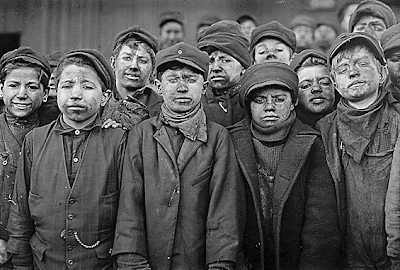
The Keating- Owen Child Labor Act sought to regulate child labor by making use of the ability of Congress to regulate interstate commerce. The act prohibited the sale of products from any factory, shop, or cannery that employed children under the age of fourteen, from any mine that employed children under the age of sixteen, and from any facility that had children under the age of sixteen working at night or for more than eight hours during the day. Although it was repealed by the Supreme Court in Hammer v. Dagenhart, it temporarily set a minimum work age and a maximum work day for children under sixteen.
LAD/Blog #28: Wilson's First Inaugural
Wilson's first inaugural address began by addressing the morals of the American people and the need for change in American society. Wilson spoke about the the success of the Industrial Revolution, though acknowledged that despite its success, it also led to many underlying issues that had become present within American society. The corruption engendered by the economic boom had to be stopped. Wilson considered there to be a great need for reform, and promised such reform as pure food laws, sanitation laws, and laws improving the labor conditions. Wilson stressed that the country needs serious change, hoping for true reform to better the nation.
LAD/Blog #27: The Clayton Anti-Trust Act
The Clayton Anti-Trust Act, passed in 1914, lengthened the Sherman Act's list of business practices that were deemed objectionable. These practices included price discrimination and interlocking directorates, whereby the same individuals served as directors of supposedly competing firms, monopolizing the business. It also conferred long-overdue benefits on labor. Conservative courts had been sabotaging trade unions, ruling against them as falling under the antimonopoly restraints of the Sherman Act. The Clayton Act was to exempt labor and agricultural organizations from antitrust prosecution while legalizing strikes and peaceful picketing.
LAD/Blog #25: Dawes Severalty Act
The Dawes Act, approved in 1887, provided land for Native Americans and described in detail the method of allotting land to them. Firstly, the government would pay for the land to be allotted to Native American tribes. 1/4 of a section would go to each head of a family, 1/8 of a section to a single person over 18, 1/8 of a section to an orphaned child under 18, and 1/16 of a section to any other person under 18. In addition to this, the act provided that if the President thought it to be in the best interests of the tribe, the Secretary of the Interior could negotiate with Indians to purchase back the land. In such a case, the land could be put up for sale to actual settlers moving west, and the Indians were free to the money they received from the purchase however they pleased. Other land not allotted to the Native Americans was not to be sold to railroads and white settlers, and the government was to use the money to help assimilate Native Americans into white culture. Furthermore, the act stated that any Indian born within the territorial limits of the U.S. is a citizen of the U.S., although probation periods applied to them. However, the act did not extend to certain tribes, such as the Cherokees, Creeks, Choctaws, Chickasaws, Seminoles, Osage, Miamies, Peorias, Sacs, Foxes, Senecas, or Sioux, and others.
LAD/Blog #26: MLK's "I Have a Dream" Speech
On August 28, 1963, Martin Luther King Jr. delivered his most iconic speech. He began discussing the emancipation of slaves, criticizing the fact that after so many years, blacks had still not attained freedom. "I have a dream," he uttered famously, that dream being of equality. "Content of character" is what he hoped would determine the greatness of a man rather than skin color. The dream was of black and white integrating peacefully, forging friendships. If "all men are created equal", blacks should not be at a disadvantage. King also warned against violent protest, which would only lead to unnecessary bloodshed. He finished with a call for freedom to ring in every state, dreaming that one day people could cry out: "Free at last! Free at last! Thank God Almighty, we are free at last!"
Monday, January 14, 2013
LAD/Blog #24: Bryan's Cross of Gold
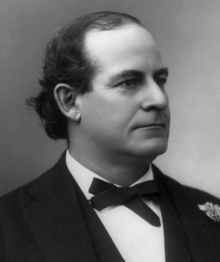
William Jennings Bryan, like the Populist Party, advocated the coinage of silver. His interpretation was that the gold standard favored the wealthy and the "trickle down theory," whereas the coinage of silver would favor the struggling peoples of the United States who could support the levels above them. Bryan asserted that cities could not exist without farms, though farms could exist without cities, and so the coinage of silver would support farmers in debt and thus the cities that needed then. Bryan also cited Andrew Jackson, saying that Democrats should be like him, fighting for the homes, families, and posterity of the common man and against the "idle holders of idle capital." Bryan ends by stating that his platform would have the backing of the the masses, and that mankind would not be "crucified upon a cross of gold."
LAD/Blog #23: The Populist Party Platform
The Populist Party's stance was that they believed there to be great inequality between American social classes. Their point of view was that monetary creation benefited the rich only, and that silver would be a preferable currency; they wanted unlimited coinage of silver in a ratio of sixteen to one. The Party wanted to increase to power to the "plan people" and provide for equality available to all men and women. The Party also asserted that Unions should be permanent, that earners of money should keep all of their earnings, and that the government needed to regulate railroads and telegraphs. To help earners of money keep their money, they were in favor of a graduated income tax, and their policies were meant to increase circulated money and aid farmers stuck in debt. The party also believed that land should not be hoarded by railroads companies or the government, but reserved for those who would settle it.
LAD/Blog #22: McKinley's War Message
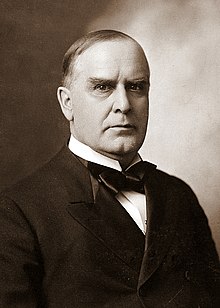
[ President William McKinley ]
Tuesday, December 11, 2012
LAD/Blog #21: Carnegie's Gospel of Wealth
Carnegie's ideas regarding the nature of wealth are expounded upon in his "gospel" He believed that people who inherited money could accomplish nothing more with it than merely living off of it, where people who nurtured and grew their fortunes were the ones who truly prospered. One of the smartest options with money, in Carnegie's opinion, was to try to grow it and always make more. He divided wealth into three categories, those being inheritance, for public purposes, and sums left to the jurisdiction of the one who possessed it. The most realistic option, he said, was the third. Carnegie also believed that the circulation of money was a vital part of social Darwinism, for it separated the rich from the poor and civilization needed to be ruled by the wealthy, in his opinion, for they made the foundations of society. But despite that, the wealthy had to be cautious and set a financial example by not being extravagent with their spending, but modest and smart, cautious investors. And in the end, a duty of the wealthy man was the duty to help his government and fellow man.
LAD/Blog #20: Emancipation Proclamation
Lincoln's controversial Emancipation Proclamation was made possible because of the victory at Antietam and abolished slavery within the Union, establishing that "all persons held as slaves within any State ... shall be then, thenceforward, and forever free." The government, he attested, would protect these peoples' rights and freedoms and those who tried to deny these rights and freedoms would have to face consequences. Therefore, any state who refused to obey the Proclamation would be deemed a rebel, and the people within it could claim that they themselves were not rebels against the Union, rather, their state was. As commander in chief, Lincoln had certain wartime powers such as sending the US Army and Navy to fight such rebels. He went on to list the areas in which slavery would be illegal, and stated and those areas had to recognize the freedmen's rights and freedoms, and that he wished to engage in violence only as self defense. He concluded by saying that freed slaves had to work faithfully and loyally as American citizens, and could now participate in the military. Lincoln's decision made with the Proclamation was serious, and he meant to enforce it, for it was an act that he "sincerely believed to be an act of justice."
LAD/Blog #19: Lincoln's Second Inaugural Address
Lincoln entered his second term with the Civil War still raging and the same challenges and struggles still fresh in his mind. The Union had to be rebuilt, and it was his duty to restore it. In his Second Inaugural Address, he stood before United States citizens and recounted the war thus far, detailing political parties and the nature of the slave population in the South, which the South believed would secure them an easy victory. Not so. Both sides, Lincoln said, prayed to the same God, and yet both sides believed that God was on their side, thus pitting God against Himself and leading people to wonder about God's will. Lincoln knew that people wondered how He could let so many citizens perish, and noted that God worked in mysterious and righteous ways. Lincoln's final, resounding message of the Address was one of peace. Peace was attainable, but American people had to help attain it. The people of America had to move on from the war someday, and after it was over help to care for each other and heal the country's wounds, "with malice toward none, with charity for all."
Friday, November 23, 2012
LAD/Blog #18: Dred Scott Decision
[ Dred Scott ]
The Dred Scott v. Sanford Supreme Court Case of 1857 was among the most controversial Supreme Court cases, declaring an act of Congress unconstitutional for the second time and rewriting the definition of a slave. The Court ruled that those born into slavery became slaves and thus were unable to ever become citizens and were unable to sue in court; thus, even though Scott had fled to the free state of Illinois, he had to be returned to his owner. The Court also ruled that Congress had no right to prohibit slavery in federal territories, also stating that Congress could not deprive the citizens of the territory of "life, liberty, or property without due process of law," according to the Fifth Amendment, referring to slaves as "property." This case established slaves as property, favoring slavery and strengthening and upholding the institution.
Subscribe to:
Posts (Atom)