Friday, November 23, 2012
LAD/Blog #14: Lincoln's First Inaugural Address
Lincoln's First Inaugural Address immediately began with the issue at hand, that of the South's threat of secession. Lincoln claimed to be unbiased, saying that he did not desire radical change for the nation, but to settle the sectional conflict diplomatically. He realized that the conflict was largely over slavery, stating that the laws behind the institution would not be changed dramatically, an attempt to pacify the South. Lincoln went on to speak of the difficulties that were ahead such as the impending threat of secession and the disunity in the nation, saying that the President would need to maintain union in the country, for without union, there would be no country to govern. Lincoln said that he would remain loyal to the Constitution, and that he believed that no rights guaranteed to the people by it have been denied. He realized that there were hardships ahead, but intended to face them with confidence and preserve the union at all costs.
LAD/Blog #13: Calhoun's Speech
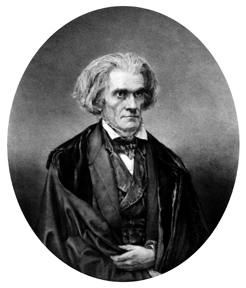
[ John C. Calhoun ]
John C. Calhoun's speech, issued on March 4, 1850, anticipated the civil war. He stated that slavery would causes disunion within the nation, describing his unsuccessful efforts to unite the feuding parties and settle the dispute and expressing the belief that politicians from all over the nation provoked the conflict. Sectionalism has been contributed to much by the dominance of the North in government; the North was predominant in all branches of government and their ideals had taken priority over those of the South, angering the South, which felt under-represented in government and as though their opinions about slavery were not able to be voiced because of that. Another issue between the North and South brought up by Calhoun was the acquisition of new territory by the treaty with Mexico; the South felt that the North was trying to exclude them from not only that territory, but revenue and disbursements, as well, because the North had received more funds than the South, leading to a battle between the South's agricultural-based economy and the North's manufacturing-based economy. But by far the most apparent issue was that of abolition. The South feared that the North's influence in government would allow slavery to be abolished, yet again overriding the South and meaning, to the South, that the so-called Union, that prided itself on equality between states, was a sham. Calhoun asserted that there was only so much overriding of the South that the North could do before civil war would be upon the country
LAD/Blog #12: Polk's War Message
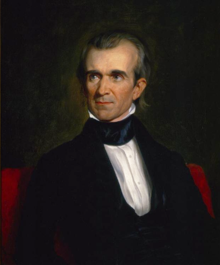
[ President Polk ]
Polk's War Message, issued on May 11, 1846, was against Mexico, stating that Mexico and its government had wronged and injured the American people and their property. Though Polk did not want to become aggressive toward Mexico, he felt as though Mexican hostilities had gone unaddressed for far too long and that war was inevitable. Examples of this hostile treatment include the harsh treatment of an American envoy to Mexico, Mexican invasion of American territory, and the shedding of American blood, for which Mexico was responsible. Though the United States still tried to maintain positive relations with Mexico, trade had dwindled and hostilities had commenced, and although both the United States and Mexico sought fair and diplomatic relations, the United States had to prepare itself for war. Polk hoped that the disputes with Mexico would be settled quickly and cleanly, but war was looming and could not be ignored.
LAD/Blog #11: Seneca Falls Convention
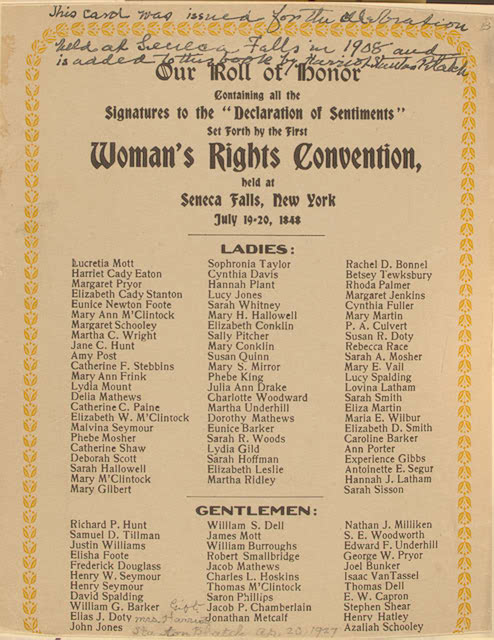
The Seneca Falls Convention led to the creation of the Declaration of Sentiments, a document that mirrored the Declaration of Independence. Where the Declaration of Independence, written in 1776, established America as an independent nation, the Declaration of Sentiments, written in 1848, sought to similarly establish women as independent and equal beings to men. Women believed, correctly, that they were being slighted, not granted the same rights as men which should have been granted to them by the Declaration of Independence. Their grievances included: the fact that they had to adhere to laws that they had had no say in creating, they had to adhere to the laws and demands laid by their husbands, even rights given to low-class men were not granted to women, legislation could oppress women with no representation, a married woman could not act politically, women could not have their own land or wages, women had a subordinate position within the church and the state, and the government had prevented women from becoming educated equally to men. Women fought to reverse these circumstances, considering themselves equal to men and asserting that the American government was run by and for the people-- thus, women, as people, should have a say in their government and how it governs them.
LAD/Blog #10: Monroe Doctrine
[ President James Monroe ]
Thursday, October 11, 2012
LAD/Blog #9: Jefferson's First Inaugural Address
[ thomas jefferson ]
Jefferson's first Inaugural Address begins with a humble thought, as he professes that he is nervous about entering the powerful office of President of the United States, and looks to the Constitution especially, as well as legislators, for guidance throughout his term. He goes on to express the idea that although the United States has a commitment to majority rule, the rights of minorities hold importance as well, and that in order to prosper, the country must unite and find common ground despite their factions. Jefferson's personal beliefs include male equality and civil rights, isolationism and freedom from alliances, and, importantly, constitutional supremacy. Jefferson concludes his Address by saying that he will serve as President until the people choose someone better to replace him.
Monday, October 8, 2012
LAD/Blog #8: Columbus
[ christopher columbus ]
A question that nags at many Americans is this: Was Christopher Columbus a hero, or a villain?
I personally do not believe that people can be classified in such black and white ways; the stark contrasts of "good" and "evil" are best left to fairytales rather than real life. However, I do believe that people come in many shades of gray.
Columbus was one of the darker ones.
Most American children are taught only that Columbus was a very admirable and excellent explorer, and it is left at that. They are grateful to him, given that his very existence gives them a day off from school. However, the true facts are that Columbus was not such a praiseworthy individual. His treatment of the Native Americans especially leads people to clamor that Columbus Day not be observed in his honor-- he treated them abhorrently, as if they were loathsome, primitive animals.
Despite the fact that cruelty toward foreign peoples was customary in his time, his acts are still unacceptable and should not be glorified. Columbus's wrongs must not be erased by history, and all Americans should be aware of them.
Subscribe to:
Posts (Atom)