Wednesday, April 10, 2013

LAD/Blog #27: The Clayton Anti-Trust Act


The Clayton Anti-Trust Act, passed in 1914, lengthened the Sherman Act's list of business practices that were deemed objectionable. These practices included price discrimination and interlocking directorates, whereby the same individuals served as directors of supposedly competing firms, monopolizing the business. It also conferred long-overdue benefits on labor. Conservative courts had been sabotaging trade unions, ruling against them as falling under the antimonopoly restraints of the Sherman Act. The Clayton Act was to exempt labor and agricultural organizations from antitrust prosecution while legalizing strikes and peaceful picketing.

LAD/Blog #25: Dawes Severalty Act


The Dawes Act, approved in 1887, provided land for Native Americans and described in detail the method of allotting land to them. Firstly, the government would pay for the land to be allotted to Native American tribes. 1/4 of a section would go to each head of a family, 1/8 of a section to a single person over 18, 1/8 of a section to an orphaned child under 18, and 1/16 of a section to any other person under 18. In addition to this, the act provided that if the President thought it to be in the best interests of the tribe, the Secretary of the Interior could negotiate with Indians to purchase back the land. In such a case, the land could be put up for sale to actual settlers moving west, and the Indians were free to the money they received from the purchase however they pleased. Other land not allotted to the Native Americans was not to be sold to railroads and white settlers, and the government was to use the money to help assimilate Native Americans into white culture. Furthermore, the act stated that any Indian born within the territorial limits of the U.S. is a citizen of the U.S., although probation periods applied to them. However, the act did not extend to certain tribes, such as the Cherokees, Creeks, Choctaws, Chickasaws, Seminoles, Osage, Miamies, Peorias, Sacs, Foxes, Senecas, or Sioux, and others.

LAD/Blog #26: MLK's "I Have a Dream" Speech


On August 28, 1963, Martin Luther King Jr. delivered his most iconic speech. He began discussing the emancipation of slaves, criticizing the fact that after so many years, blacks had still not attained freedom. "I have a dream," he uttered famously, that dream being of equality. "Content of character" is what he hoped would determine the greatness of a man rather than skin color. The dream was of black and white integrating peacefully, forging friendships. If "all men are created equal", blacks should not be at a disadvantage. King also warned against violent protest, which would only lead to unnecessary bloodshed. He finished with a call for freedom to ring in every state, dreaming that one day people could cry out: "Free at last! Free at last! Thank God Almighty, we are free at last!"

Monday, January 14, 2013

LAD/Blog #24: Bryan's Cross of Gold


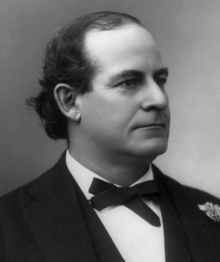
William Jennings Bryan, like the Populist Party, advocated the coinage of silver. His interpretation was that the gold standard favored the wealthy and the "trickle down theory," whereas the coinage of silver would favor the struggling peoples of the United States who could support the levels above them. Bryan asserted that cities could not exist without farms, though farms could exist without cities, and so the coinage of silver would support farmers in debt and thus the cities that needed then. Bryan also cited Andrew Jackson, saying that Democrats should be like him, fighting for the homes, families, and posterity of the common man and against the "idle holders of idle capital." Bryan ends by stating that his platform would have the backing of the the masses, and that mankind would not be "crucified upon a cross of gold."

LAD/Blog #23: The Populist Party Platform

 
The Populist Party's stance was that they believed there to be great inequality between American social classes. Their point of view was that monetary creation benefited the rich only, and that silver would be a preferable currency; they wanted unlimited coinage of silver in a ratio of sixteen to one. The Party wanted to increase to power to the "plan people" and provide for equality available to all men and women. The Party also asserted that Unions should be permanent, that earners of money should keep all of their earnings, and that the government needed to regulate railroads and telegraphs. To help earners of money keep their money, they were in favor of a graduated income tax, and their policies were meant to increase circulated money and aid farmers stuck in debt. The party also believed that land should not be hoarded by railroads companies or the government, but reserved for those who would settle it.

LAD/Blog #22: McKinley's War Message

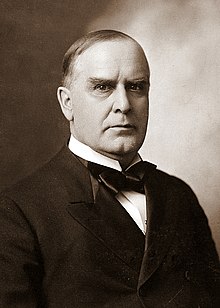
 [ President William McKinley ]

President William McKinley's message is to Congress, asking for permission to enter into a war against the Spanish to aid the Cuban independence effort. McKinley briefly explained the background of the war, the past three years that had negatively impacted American trade and the hostilities that had taken a toll on the Cubans. McKinley believed that the United States could create peace between Cuba and Spain by using neutral intervention, because he considered it immoral and unjust for the United States to ignore bloodshed occurring "right at our door," saying as well that America had a duty to help Cuba, and also that the war was harming not only Cuba, but the United States itself. The danger posed to the United States was especially apparent in the destruction of the U.S.S. Maine, and McKinley believed that Congress had to consider allowing intervention in the war in order to achieve a compromise and a stabilized Cuban government.

Tuesday, December 11, 2012

LAD/Blog #21: Carnegie's Gospel of Wealth

 
 Carnegie's ideas regarding the nature of wealth are expounded upon in his "gospel" He believed that people who inherited money could accomplish nothing more with it than merely living off of it, where people who nurtured and grew their fortunes were the ones who truly prospered. One of the smartest options with money, in Carnegie's opinion, was to try to grow it and always make more. He divided wealth into three categories, those being inheritance, for public purposes, and sums left to the jurisdiction of the one who possessed it. The most realistic option, he said, was the third. Carnegie also believed that the circulation of money was a vital part of social Darwinism, for it separated the rich from the poor and civilization needed to be ruled by the wealthy, in his opinion, for they made the foundations of society. But despite that, the wealthy had to be cautious and set a financial example by not being extravagent with their spending, but modest and smart, cautious investors. And in the end, a duty of the wealthy man was the duty to help his government and fellow man.